



Summary of RTP
RTP informs players how much value a slot is designed to return over time. Operators see the same number and read margin, bonus risk, player value and lobby strategy.
One number. Huge impact.
RTP stands for Return to Player. It is the average of all wagers a casino game is designed to give back over a large amount of play. A 96% RTP slot is designed to pay out 96 of every 100 wagered over time. The other 4 becomes the house edge expected
That number can be ignored for one spin or one full session.
A slot with a low RTP can give a player a big win. A higher RTP slot can lose quickly to another player. Those kinds of random results. RTP is a long run guide, not a promise of payout for tonight.
Use RTP as the initial filter. The full ride includes volatility, hit rate, max win, bonus rules, stake range, game speed, feature cost and provider settings.
Key Facts on RTP
RTP is an acronym for return to player.
The number indicates how much a casino game is designed to return relative to the total amount wagered. A slot with 95% RTP is designed to pay back 95 of every 100 wagered over a large number of plays.
Real data is used in actual RTP.
Recipe:
Real RTP = total winnings / total bets * 100
For example:
If players bet 812,000, and the slot pays out 720,000 in prizes, the actual RTP is 88.67%.
Theoretical RTP is different. This figure is set by the game providers during the design of the game. It looks at pay tables, reel layout, symbol weights, jackpot rules, bonus triggers, max win limits and simulation tests.
Players can usually find the theoretical RTP on slot reviews, casino game pages, pay tables, and help menus. Over short periods of time the real RTP can be higher than that listed number or lower.
The average online slot return rate is around 96%. Games >96% are looking stronger for long term value. Slots below 94% have a bigger house edge and need a good reason to be on board, like progressive jackpot setup or feature-rich gameplay.
Keep in mind: RTP does not dictate your next spin. The moment is still decided by random game results.
Low, Medium and High RTP Differences
RTP levels allow players to compare games more quickly. Operators use the same levels to drive margin, promotions, and game mix.
A quiet reason to be in town is a low RTP slot. Jackpot heat, rare max win potential, a popular theme, or a strong bonus round can all bring the appeal. Without that hook, it feels like a costly game.
Medium RTP is the commercial middle ground. So, operators get margin space to work. Players still get a return level that doesn’t feel immediately punishing. This zone is good for casual play as the game can focus on theme, pace and bonus rhythm.
High RTP draws sharper players. The percentage looks cleaner, the house edge goes down, and the game gets a better comparison value. But high RTP doesn’t automatically make a slot gentle. The balance can still be drained in a dry run due to high volatility.
Why RTP is Important in Slots?
 AI-generated artwork created with a ChatGPT-written art prompt
Now players are comparing values before they spin.
First, the theme is striking. Then the number is verified. RTP gives players a fast way to compare a lobby full of classic slots, Megaways games, jackpot titles, bonus buy releases, cluster pays slots and branded games.
Online slots are usually around the 96% mark. Players see better long-term value above that level. To draw attention under that mark, the slot needs a good reason, like a progressive jackpot, richer bonus round, bigger max win or famous theme.
The deeper slot made RTP more important. Free spins, multipliers, wilds, re-spins, hold and win rounds, bonus buys, gamble features and jackpot meters can all alter the feel of value. Pretty reels alone won’t do it for the session.
Players want adrenalin. They still check the number.
A slot with an RTP of 96% has a house edge of 4% in the long run. Easy on paper. Messy in practice. One player gets free spins in ten spins. Another hits a dry patch and sees the balance go down. Every result is independent RNG keeps it that way. RTP stays a guide not a refund plan.
Volatility makes RTP have its mood. Low volatility slots offer more frequent smaller wins. High volatility slots can stay cold before hitting harder. Two slots can have the same RTP and feel completely different.
Operators care as well. High RTP slots attract value conscious players. Feature-heavy slots appeal to players looking for big moments. Prize hunters who take the sharper swings are drawn to jackpot slots.
Numbers open doors. Reels still have to earn the spin.
RTP Types in Slot Games
RTP has more than one side. The game rules have one number, but behind that number is an entire payout model.
Players want labels. Plain and simple. Operators require clean reporting. Both are needed on review pages.
Theoretical RTP
Theoretical RTP is the target payout programmed into the game when it is launched. It is set by providers via symbols, reel weights, pay tables, bonus odds, feature rules, jackpot design and long test runs.
The 96% theoretical RTP means the game is designed to give back 96 of every 100 wagered over the long term. The remaining 4 is the house edge expected.
Theoretical RTP is used by operators to mould the commercial lane. A higher RTP can attract value driven players and help to facilitate longer sessions. Lower RTP can help increase margin, but it puts more pressure on the game to deliver more compelling entertainment, better features or bigger prize appeal.
Theoretical RTP can be used as a filter by players. More often than not, a higher number indicates better long run value but does not protect one session. Still get cold runs. Big wins still occur. The randomness makes the session crazy.
Real RTP
Actual or real RTP is the return the game has made from actual play over a period of time. The total winnings divided by the total bets, then multiplied by 100.
In small samples, the number can swing hard. Rare bonuses, jackpots and high volatility results have not settled yet, so the actual RTP of a new slot can show a lower or higher percentage after a few thousand spins. More play data = clearer picture.
Operators use real RTP as a live health check. If a game keeps drifting outside its expected range with enough play, the operator or supplier needs to investigate the data, game setup or reporting flow.
Players should be wary of actual RTP. An online casino may have hot live returns but that does not mean the next spin is any warmer. No liability is created by past payout data. The next result is still lonely.
Advertised RTP
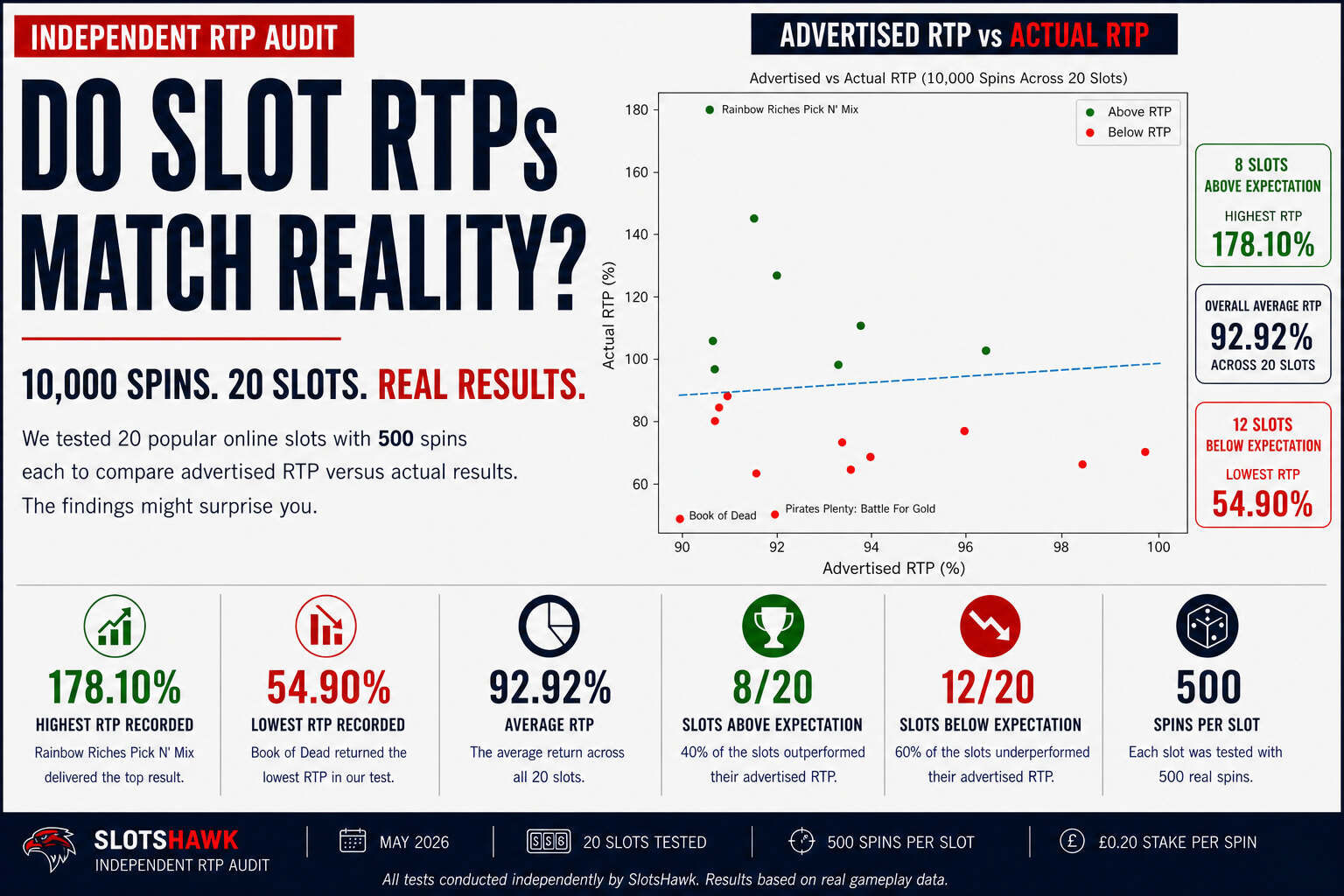 Advertised RTP VS Actual RTP based on 10,000 spins in 20 slots│source∶ SlotsHawk
Advertised RTP is the number presented in the game rules, pay table, casino page or slot review. It is the first number most players see.
Operators want this to be readily available and accurate. Hidden RTP is a confidence killer. Old RTP degrades content quality. Wrong RTP damages the brand faster.
Players should always read the rules of the game before betting real money. Reviews can be useful, but it’s the live version of the casino that matters most. Different payout settings can happen on the same title but different site.
Variable RTP
Variable RTP means there is more than one approved payout version of the same game from a provider. The name of the slot might look the same, but the math behind it is different.
Operators choose the version that best suits their market, bonus model, margin target and player strategy. High RTP versions can attract value seekers. A lower RTP version can protect bonus cost, but it needs stronger disclosure and cleaner product positioning.
The effect players feel is long run value. 96.5% and 94% can look the same on the reels but the long run cost is different. The smart move is still easy. Open the pay table, check the RTP and then decide if the game still deserves the spin.
RTP Base Game
Base game RTP is the return from normal play and does not include special jackpot contributions or separate paid feature mode.
Operators set the core value of a slot with the base game RTP. If the base game is too dry, players may leave before the bonus lands. If it happens too often with too little margin, the game might become weak for business goals.
Most spins are in the base game so you should check the base game RTP. Not everyone can save a weak base game with a good bonus. The main reels must have their own rhythm.
RTP Feature
Feature RTP comes with free spins, pick games, respins, multipliers, gamble tools and other special parts of the game.
Operators care because features drive excitement, replay and the shareability of content. A good feature can make a regular slot a lobby magnet. But feature heavy games tend to be higher volatility which can mean more pronounced balance swings.
Check out the RTP of the feature and bonus frequency. A well paid, rare landing bonus can be brutal. If you want more action and less waiting, a smaller feature that hits more frequently might be more appealing.
RTP of Bonus Buy
Bonus buy RTP is when a player pays a fixed price to enter a feature. Some of the slots have the same RTP as regular play. Others have a separate RTP for the bought feature.
Bonus buys are used by operators to appeal to players who want instant feature action. “The hazard is speed. Higher initial costs can burn through bankrolls more quickly, especially if players chase poor bonus results.
Players have to check the buy price, RTP, volatility and max win before hitting the button. A 100x bonus buy is not a way to find value. It’s a bigger bet in a more flamboyant get-up.
Jackpot Payout to Player
Jackpot RTP refers to the portion of the return associated with fixed, local, network or progressive jackpots. In some games the RTP is listed as one combined figure. In others the base game and the jackpot part are shown separately.
Operators use jackpot RTP to create excitement and prize pool appeal. “A big progressive can bring traffic, improve visibility and give the lobby a headline. The trade is in the regular game return, which could feel thinner if a portion of each stake goes to the prize pool.
Players need to distinguish the dream from the daily ride. A jackpot can change everything in a second, but the odds are slim. If the base game is feeling lacklustre, then the jackpot is stealing too much of the fun.
Return to Player Game Mode
Some games have a return that varies by mode. A slot can be set to normal spins, ante bet, bonus buy, super bonus buy, gamble feature or side feature. Each mode may have a risk profile of its own.
Operators use these modes to provide more choice to players and stronger product depth. More choice also means more responsibility. Clear rules, clear costs and clear payout information for each mode.
Players should consider each mode as a separate bet. Ante bet increases chance of feature, increases stake size. Super bonus buys can be a bigger prize path but they punish the balance quicker. The labels count. Price is more important.
RTP Progressive
Progressive RTP changes as the jackpot pool grows over time. The math in the base game might stay the same, but the total value can climb as the prize climbs.
Progressive games create a sense of urgency for operators. The growing prize pool provides a natural hook for the lobby movement and for campaigns.
Players need to understand that a bigger jackpot does not mean each spin is safer. The progressive prize raises the headline value, but regular results can still be tepid. Sharp swing, deep pool.
Return to Player Skill Based
Skill-based RTP is present in games where the choices of the player determine return. Common examples are Blackjack and Video Poker. The return can be even bigger with good decisions. It is burdened with bad decisions.
Operators use these games to reach players who like control, rules and strategy. The margin depends on game rules and how players act.
Players need to learn the proper play style before chasing the listed return. When choices are weak, a high RTP table can lose its edge quick.
RTP Short Term
Short term RTP is what a player sees in a session, a day, or a small sample. It may land well above or below the number listed.
Operators should not use short term results as evidence of a game’s quality or lack of quality. Small samples make for drama, not certainty.
A lucky session should not make players think there is a pattern. The game didn’t go well. One rough session isn’t proof that the slot is broken either. Random results can be savage and sweet in the same minute.
Long-run RTP
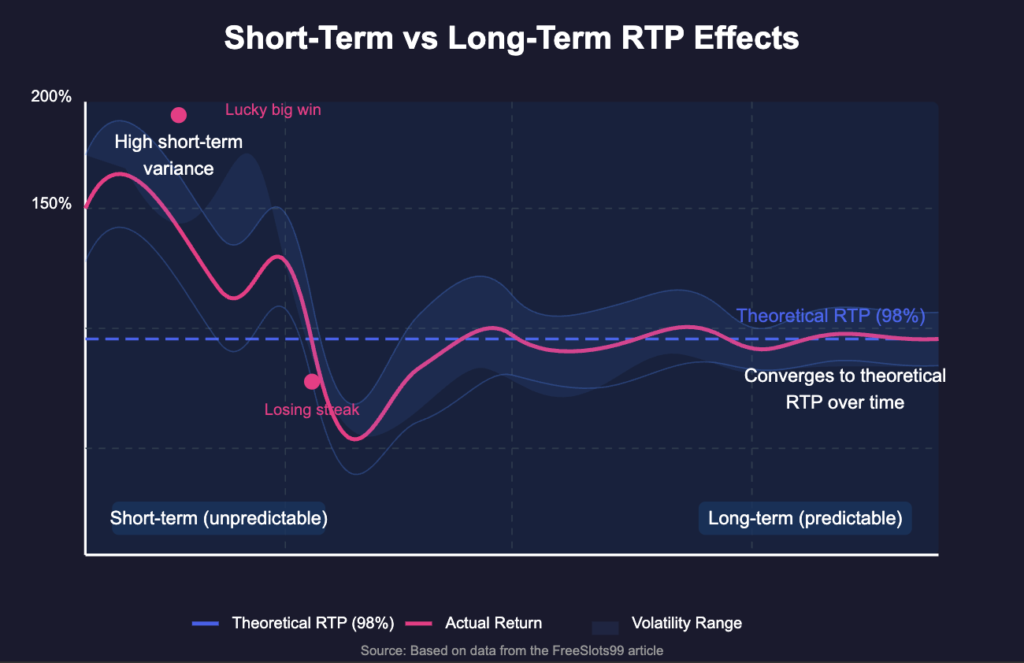 Short-run VS Long-run RTP effects│ source∶ FreeSlot99
That’s where the list percentage begins to add up in the long run RTP. The more rounds measured, the more the result should approach the designed return, within a normal tolerance range.
Operators use long run RTP to verify performance, ensure compliance & manage portfolio health. This helps to identify errors, weak reporting or a version of the game that does not match the expected setup.
Players can use long run RTP to make smarter selection. The higher the RTP, the lower the expected cost over time, especially if you also have lower volatility and a reasonable stake size. The house still has the edge, but better math provides the player a better seat.
Slots & Casino Games RTP
RTP can be found in all casino products, but slots offer the greatest variety of payout styles.
You can have a five-reel video slot, a Megaways title, a classic fruit game and a progressive jackpot slot all sitting in the same lobby with very different payout models.
Classic slots tend to keep the action simple. Keep rules simple. Pay tables are brief. Win caps are often lower, while RTP can be high.
Video slots have more features. Free spins, wilds, scatters, respins, multipliers, pick rounds and bonus buys can push volatility higher.
Megaways slots feature changing reel structures and large ways to win. The number of titles in the medium RTP range is plenty, but they can feel sharper as bigger wins are harder to land.
Progressive Jackpot Slots – A portion of every wager is added to the prize pool. The jackpot is getting noisier, but regular payouts can feel leaner.
Blackjack can offer very high RTP with good rules and right decisions. Poor play diminishes the return.
Roulette is a wheel game. European roulette has better RTP than American roulette due to one zero instead of zero and double zero.
Baccarat banker bets can be pretty high as the house edge is low compared to many casino wagers. Video poker can climb even higher, with the right pay table and right play.
Slots are different because the player usually can’t change the math by making decisions. Choose the game, look at the RTP, choose the volatility, set the limit before playing.
RTP VS House Edge VS Variance
The player side of the math is shown by RTP.
House edge shows the casino’s advantage.
The formula is easy:
RTP + House Edge = 100%
What is the house edge of a 96 % RTP slot? A 95% RTP slot has a 5% house advantage. A 94% RTP slot has 6% house edge. A 97.30% RTP European roulette game has a 2.70% house edge. A 94.74% American roulette game has a 5.26% house edge.
But the story is different with volatility. It explains how wins come to be.
Both slots can have 96% RTP. Small wins pay off frequently. Another has much of its value in rare bonuses. Same target for return. Very different ride.
Variance is a term used to describe the movement of actual results away from theoretical RTP over a period of time. Players feel it as streaks, dry spells and sudden hits.
It is important to: Read all three in sequence. RTP is back. Cost shows house edge. Volatility has a rhythm to it.
Top Slots Game Providers to Compare by RTP
Slot providers matter because every studio handles RTP, volatility, bonus design, and game rhythm in its own way.
A provider name gives a useful first clue. The pay table gives the final answer. The same slot title may run with different RTP settings across casinos, so the active game rules must be checked before a review goes live.
|
Slot Provider |
RTP Profile |
What to Compare |
Best Review Angle |
|
NetEnt |
Known for several high RTP classics and popular low volatility titles |
Mega Joker, Blood Suckers, Starburst, Dead or Alive 2, jackpot titles |
Strong for comparing classic value, simple rules, volatility range, and legacy slot appeal |
|
Playtech |
Offers high RTP examples across classic slot formats and branded casino content |
Ugga Bugga, Goblin’s Cave, older classic style releases, branded slots |
Useful for players who want clear math, direct features, and easy pay table reading |
|
Relax Gaming |
Mixes high RTP slots with sharp volatility and modern bonus tools |
Book of 99, Marching Legions, Dream Drop titles, bonus buy options |
Best for checking how bonus buys, max win, and volatility change the RTP feel |
|
Thunderkick |
Often reviewed for creative slot design with high value examples |
1429 Uncharted Seas and other feature led releases |
Good for players who want strong RTP with personality in the design |
|
Yggdrasil Gaming |
Balanced portfolio with medium to high RTP examples and playful features |
Jokerizer, Vikings style slots, mystery prize tools, feature collections |
Works well for comparing steady RTP with bonus pacing and mobile flow |
|
Big Time Gaming |
Best known for Megaways mechanics and high volatility slot action |
White Rabbit Megaways, Bonanza style formats, changing ways to win |
Strong for showing why high RTP can still feel risky when volatility climbs |
|
Pragmatic Play |
Large slot library with varied RTP versions, high volatility games, and feature rich releases |
Pay table version, bonus buy rules, max win, ante bet settings |
Important for checking the live RTP version because the headline game name is not enough |
|
Nolimit City |
Known for high volatility slots, bold max wins, xWays style tools, and feature buy options |
Base RTP, feature buy RTP, volatility, max win ceiling |
Best for risk hungry players who want bigger hit potential and can handle dry spells |
|
Hacksaw Gaming |
Often uses compact reels, bonus buy choices, and sharp volatility |
Base game RTP, feature buy RTP, bonus cost, hit rhythm |
Best for checking whether quick play speed and feature buys increase bankroll pressure |
|
Blueprint Gaming |
Strong in branded slots, jackpot features, and familiar bonus formats |
Fishin’ Frenzy style games, jackpot versions, bonus rounds |
Useful for comparing player friendly themes with jackpot cost and feature frequency |
How is Casino Math Value for the Player?
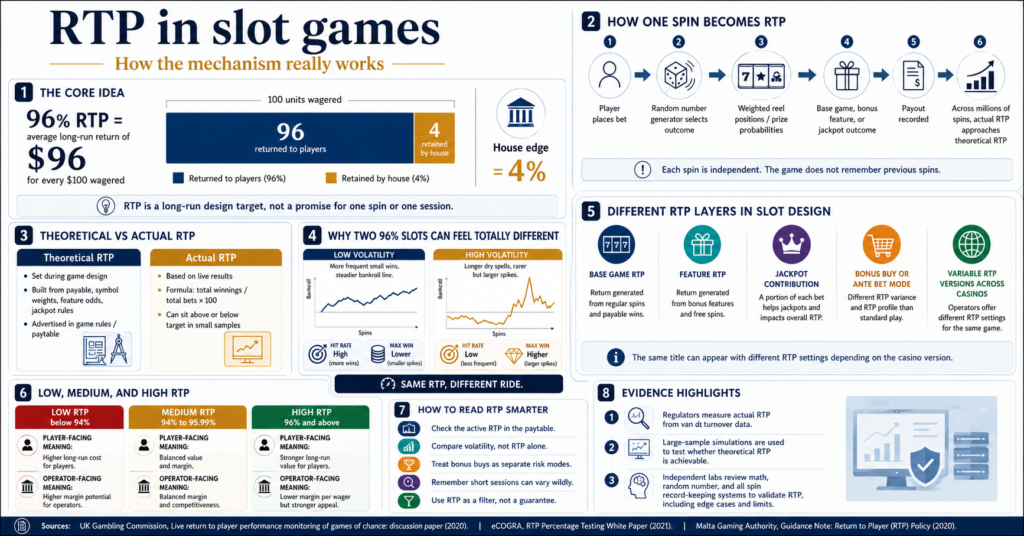 AI-generated infographic created with a ChatGPT-written art prompt
Game math begins before launch.
A provider builds the payout model through the symbols, reel stops, prize values, bonus odds, feature costs, jackpot rules, and maximum win limits. The test then checks that the game is near its target RTP over a large sample of plays.
RNG takes every round.
RNG stands for random number generator. The system generates a result which the game translates into reel stops, cards, numbers or prize outcomes. It has no record of the last time it spun. There is no bonus due on it. Each round is brand new.
Providers design the RTP by allocating more random numbers to lower paying outcomes and fewer random numbers to larger prizes or bonus triggers. That’s how a 96% slot can be random and still have a long run payout target.
Audit labs look at RNG systems and payout behaviors. Fair game checks are important in regulated iGaming, so you’ll find names like BMM, iTech Labs, eCOGRA, and GLI.
The feeling for the players is never clean. One of the 5 spins hits a bonus. another waited 300 spins and got scraps Same game, another run.
RTP gives you the big picture. RNG controls the moment.
Best RTP Slots to Check Out
Best RTP slot reviews combine high payout numbers with real play context.
A 99% RTP slot can still feel rough if the volatility is high. With regular wins and simple rules, a 96% slot can feel more fluid. RTP, volatility, max win, hit rate and bonus design sitting side by side increases review value.
|
Slot Game |
Provider |
Listed RTP |
Listed RTP |
Why Review it? |
|
Goblin’s Cave |
Playtech |
99.32% |
Check pay table |
A strong high RTP example for players who want top end long run value |
|
Ugga Bugga |
Playtech |
99.07% |
Low |
Good for showing how a simple classic format can carry a very high return figure |
|
Mega Joker |
NetEnt |
99.00% |
High |
Useful for explaining how high RTP and high volatility can live in the same slot |
|
Book of 99 |
Relax Gaming |
99.00% |
High |
Strong for reviewing bonus buy impact, book style features, and risk profile |
|
Jackpot 6000 |
NetEnt |
98.90% |
Medium |
Good for players who like retro fruit slot flow with higher return potential |
|
1429 Uncharted Seas |
Thunderkick |
98.60% |
Low |
Works well for comparing high RTP with frequent smaller wins and feature depth |
|
Marching Legions |
Relax Gaming |
98.12% |
Check game rules |
Useful for checking how bonus buy mode can change the RTP picture |
|
Blood Suckers |
NetEnt |
98.00% |
Low |
A strong review pick for low volatility play and classic free spins value |
|
Jokerizer |
Yggdrasil Gaming |
98.00% |
Medium |
Good for players who want steady rhythm with extra prize features |
|
White Rabbit Megaways |
Big Time Gaming |
97.77% |
High |
Best for showing how Megaways reels can mix strong RTP with sharper swings |
|
Dead or Alive 2 |
NetEnt |
96.82% |
High |
Strong for explaining sticky wild free spins, dry spells, and large max win appeal |
|
Divine Fortune |
NetEnt |
96.59% |
Medium |
Useful for reviewing jackpot style play with a return figure above many prize pool slots |
|
Starburst |
NetEnt |
96.09% |
Low |
A clear pick for simple mobile play, wild respins, and steady session feel |
|
Buffalo King Megaways |
Pragmatic Play |
96.00% |
High |
Good for comparing Megaways risk, max win appeal, and active RTP version checks |
|
Mega Fortune |
NetEnt |
96.60% |
High |
Strong for reviewing progressive jackpot trade offs and prize pool attraction |
The best RTP slot review isn’t just about picking the highest number and leaving.
A top list should distinguish low volatility value slots from high volatility chase slots. Classic reels, Megaways games, bonus buy titles, jackpot slots and mobile first releases all require different scoring notes.
Makes sense for longer play with high RTP low volatility. Bold players still like high volatility with high RTP for bigger prize hunting. For jackpot lovers, a lower regular return might seem fine when the prize pool is creating real heat.
Every slot has a mood. RTP is math. Volatility dictates the pace.
Gameplay Experience
RTP draws attention. Game play keeps the hand near the spin button.
Controls must be clear, loading times fast, rules simple, balance display clean, stake changes fair and the pay table easy. If the RTP is behind five taps and tiny text, confidence drops.
Good gameplay makes risk easy to read. The player should be able to see the stake, paylines, bonus rules, max win, feature buy cost and volatility effortlessly.
Session louder through graphics. Sound can add flavor. Neither cures weak math.
Mobile play is even more vital. A slot that runs smoothly on a desktop can feel clunky on a phone if the buttons are too close together or the help menu loads too slowly.
A clean screen does more than look good. Choices are best before money moves.
Bonuses and Promotions
RTP and bonus value are not equal.
A 96% RTP slot with tough bonus conditions could feel bad. Wagering rules, game contribution rates, maximum bet limits, expiry windows, excluded titles and withdrawal caps can quickly diminish the value.
A clean review is needed for free spins. Show game, spin value, wagering rule, max win cap, expiry time.
Cashback has to be treated the same way. If the payout cap is low or if the terms block popular games, a large percentage is less.
Bonus buys need a warning of their own. For some games, the RTP is different in feature buy mode. Other games have the same RTP but increase the risk of the session because the player bypasses the base game.
Jackpot promotions require a context. The excitement is the big prize pool but the regular return may be less as part of each bet goes into the jackpot.
The offer can be bright. The rules make the bite.
How IGL Reviews Slot Games with RTP?
IGL sees RTP as a whole part of the game and not a single statistic.
But a high RTP slot can still feel rough if volatility is fierce. But, a lower RTP jackpot game can still be tempting if the prize pool is obvious and the risk is upfront. The score is set by the context.
RTP version check doneA single title may have multiple RTP settings. The provider might offer a few predefined options. One of them is in the casino. Players cannot change that version. Regulated casinos cannot switch midsession to make a player lose. |
RNG check and regulationEach result is independent of RNG. Regulated game requires tested software and certified maths. Lab checks are useful to confirm that the published RTP, random results and payout model work as claimed. |
Max win and hit rate testMax win indicates the prize ceiling. Hit rate is the frequency any win may appear. Both can be misleading out of context A high hit rate can mean many wins below stake. Rare feature triggers can hide a big max win. These numbers should stay next to RTP and volatility on review pages. |
Volatility testingVolatility is the speed of payout. Low volatility games pay smaller wins more often. Medium volatility gives a good feel. High volatility games can go cold then pay out harder. A player on a limited budget might prefer low volatility. Bigger bankrolls could allow players to endure higher volatility for the chance of bigger potential payouts. |
Feature checkFree spins, wilds, scatters, multipliers, gamble rounds, sticky symbols, respins, jackpot wheels and feature buys can change how value feels. A feature should be simple to explain. If the player doesn’t get how it works, the excitement is lost. |
Provider checkThe studio makes a difference because game rules, mobile quality, testing and support are different by studio. Playtech, NetEnt, Relax Gaming, Yggdrasil Gaming, Pragmatic Play, BGaming, Big Time Gaming, Blueprint Gaming, and Nolimit City are all names that you’ll hear a lot in RTP discussions because their games are heavily reviewed. The final say still belongs to the pay table.
|
Demo CheckDemo mode allows players to learn the rules and try out the bonus flow and feel the pace without having to bet money. You can’t prove RTP on a demo play through, but you can tell if the game ‘feels’ right. |
Mobile PlayMobile play should be a slick experience. RTP information should be easy to read on a small display. |
Why RTP Remains Popular with Players?
RTP stays popular because it gives players a fast value signal.
No spreadsheet needed. One number tells the player how much of all wagers the game is built to return over time.
The danger sits in misreading it. A player may think 96% RTP means 96 back from 100 in one session. That is false. Results can land far above or far below the target in short play.
RTP also supports bankroll planning. A player who wants longer sessions may lean into higher RTP and lower volatility. Prize hunters may chase higher volatility titles, even with lower regular returns.
For operators, RTP helps shape the casino lobby. High RTP games support value seekers. Jackpot games attract dream chasers. Feature heavy games bring entertainment pull.
A balanced casino offers variety and labels the risk clearly.
Other Metrics that Go Along with RTP
RTP needs a partner.
Below are metrics close to the payout figure with details that you should know before start playing:
|
Metric |
Plain Meaning |
Reason to Know |
|
Volatility |
Win size and win frequency feel |
Match game risk with player budget |
|
Variance |
Short term result swing from expected return |
Explain why sessions feel uneven |
|
Hit rate |
How often any win may land |
Show action frequency |
|
Max win |
Highest listed payout cap |
Show prize ceiling |
|
Stake range |
Minimum and maximum bet |
Check budget fit |
|
Bonus frequency |
How often features may trigger |
Set feature expectations |
|
Bonus buy cost |
Price to enter a feature |
Show risk jump |
|
Jackpot type |
Fixed, local, or progressive prize |
Explain prize pool impact |
|
Game speed |
How fast rounds play |
Show bankroll pressure |
|
Provider |
Studio behind the game |
Check rules, support, and version clarity |
A lonely RTP figure, it looks neat. A full and comprehensive payout metrics checklist tell truth quicker.
How RTP Impacts Operators?
RTP influences casino strategy from the lobby to the bonus page
High RTP games bring value seekers review clicks and longer session potential. Mid range RTP games help strike a balance between entertainment and margin. Games with a lower RTP need a reason for being – be it progressive jackpots, famous themes, bigger max wins or feature packed gameplay.
Operators also use RTP to control bonus exposure. You can create sharper cost with a high RTP low volatility game with a generous bonus. A lower RTP game can protect margin but players will notice if the offer feels thin.
Game aggregators matter, too. The broad provider mix gives operators greater control over choices for players, variety of themes, volatility distribution and payout profile.
Retention – Disclosure of Clean RTP. Players are more forgiving of losing spins when the rules are clear. Confusion destroys confidence. Hidden numbers create friction before the reels even start to spin.
Here’s what a clean operator workflow looks like:
- Start the game at the targeted casino.
- Check the paytable and rules.
- RTP, volatility, Max win, Hit rate and stake range recorded.
- See if the game comes in different RTP versions.
- Review features buy and bonus contribution rules
- Try mobile play and demo mode where you can.
- Update the page when the casino version is changed.
Casino content wins when the numbers remain current.
How RTP Influences Players?
RTP affects player decision-making, bankroll management & session feel.
Better long-term value means a higher RTP. The lower the RTP the more the game keeps it over time. The difference may seem trivial, but it does add up over many spins.
Volatility changes the feeling. A 96% low volatility slot can feel consistent. A 96% high volatility slot can be hungry and then explode on you. Same RTP. Different pulse.
Best read for players is to check RTP with volatility, hit rate, max win, bonus rules and stake range. So a number begins the tale. Full game rules are at the end.
If a player wants longer play, he can opt for higher RTP with lower volatility. A prize hunter might take on more volatility for a bigger possible hit. As long as the prize pool provides the spark, a jackpot fan might accept the lower regular return.
The smarter move is not to chase the biggest number alone. Match the math to the mood of play.
What IGL Thinks About RTP?
RTP is one of the strongest facts in iGaming content in slots review because it gives players a quick read on value, according to IGL Online Casino News.
The number works best beside the right support. Volatility, variance, house edge, hit rate, max win, bonus rules, RTP version, and mobile flow all change the real player experience.
Weak reviews copy a percentage and move on. Strong reviews test the game, read the rules, and explain the risk in plain words.
For online casino brands operation, clear RTP content on slots review improves product quality.
For affiliates, it builds sharper comparison pages. For players, it makes the next click less blind.
The spin is still random. The choice before the spin can be smarter.
Play Responsibly with RTP:
- RTP lets players compare games. It is not a bankroll saver.
- Set a budget before you play. Select a session time. Stop when you’ve hit the limit. Don’t chase losses.
- Even a high RTP slot can suck a balance dry on a cold run. Low volatility has its risks. A jackpot game can be attractive with the odds remaining sharp.
- Use safer play tools sooner. Deposit limits, time outs, reality checks, self-exclusion and account history all assist in keeping control in the hands of the player.
What You Need to Know about RTP?
Meaning of RTP
RTP is return to the player. It is the average portion of total wagers a game is designed to pay back over a large number of plays.
RTP in one session
A short run can be very far from the listed RTP. The number doesn’t determine your next spin, hand, round or bonus.
Theoretical RTP
The game design is driven by the theoretical RTP. It is determined by game rules, pay tables, feature odds and testing.
Actual Return to Player
Actual RTP takes real play data. The real payout percentage for that sample is total winnings divided by total bets then multiplied by 100.
Table Advantage
House edge = 100% – RTP The house edge for a 96% RTP game is 4%.
Volatility and the Role of the State
Volatility is how wins come. Low volatility leads to more frequent small wins. High volatility means bigger potential hits and longer dry spells.
Variance
Variance is the degree to which actual results can differ from expected RTP over a period. Short runs can swing hard.
RNG
RNG makes sure every game result is random and independent. Past wins do not guarantee future ones.
Variable Return to Player (RTP)
Some online slots may offer different provider-approved RTP versions. The active version should be visible in the game rules or paytable.
Online & Land Based RTP
Online games have lower overheads and therefore online slots often have a higher RTP than land-based slots. The exact number is still dependent on the version of the game.
Slots with High RTP
A good RTP for slots often begins around the 96% marker. Games above 97% are looking good, games below 94% have a heavier long run cost.
Table Game Return to player
Blackjack and video poker can give you high RTP with the right rules and play. Roulette depends on the type of wheel and the rules of the table.
Jackpots – progressive
These types of slots also tend to have lower regular payouts as a percentage of each wager is contributed to the prize pool. The headline is the big win. RTP illustrates the trade.
Bonus Purchases
Bonus buys can change risk quickly. Some games have different RTP settings for feature buy mode and require a fresh look at the rules.
Demo Mode
Demo play lets players test rules, features and pace. It can’t prove RTP in a short sample.
Better Game Choice
Check the pay table. Match the volatility. Set the limit. Spin with eyes open.